
Employee engagement initiatives are typically implemented top-down by executive leadership and HR. Most organizations survey their population annually to measure engagement and then develop organization action plans to address opportunities. These actions normally address topics like top-down communication, collaboration, or improving employee voice. But little is done to address an important gap between individual employee talents and job fit.
How Does Job Fit Relate to Employee Engagement?
TMA Performance measures job fit using employee surveys with organizations around the world. Our global benchmark shows that 78% of employees agree with the statement: “My talents and abilities are used well in my current position.”
Not surprisingly, this result mirrors the TMA Performance overall Employee Engagement Index where 78% of employees are engaged in their work. In fact, those that disagree that their talents and abilities are used well, are also more likely to be disengaged in their jobs.
How Does Impact Relate to Job Fit and Drive Employee Engagement?
Using multiple regression analysis on employee survey results, we find that one of the common drivers of employee engagement is experiencing a sense of impact from the work. When employees feel like their work contributes in a meaningful way to the success of the organization, they are more motivated, energized, and committed to the job they do. A sense of impact is magnified when employees feel like the work they do matches their natural talents and interests.
Why Is it Important to Measure Talents?
Our research shows that employees are motivated when their job tasks and activities align with their personal needs and talents. 360 feedback surveys do an excellent job of measuring the competencies of individuals, but these assessments don’t determine what talents contribute to each competency. The next step is to measure and quantify the talents of each individual so leaders can match people with the work that they are best suited for.
What Is the Best Way to Measure Individual Talents?
Drives are the building blocks of personality. In other words, drives define personality. Drives have a major influence on people’s behavior and (potential) development. The TMA Assessment measures 22 research-based Drives to define personality and measure individual talents. Talents are determined based on a person’s preference for each drive.
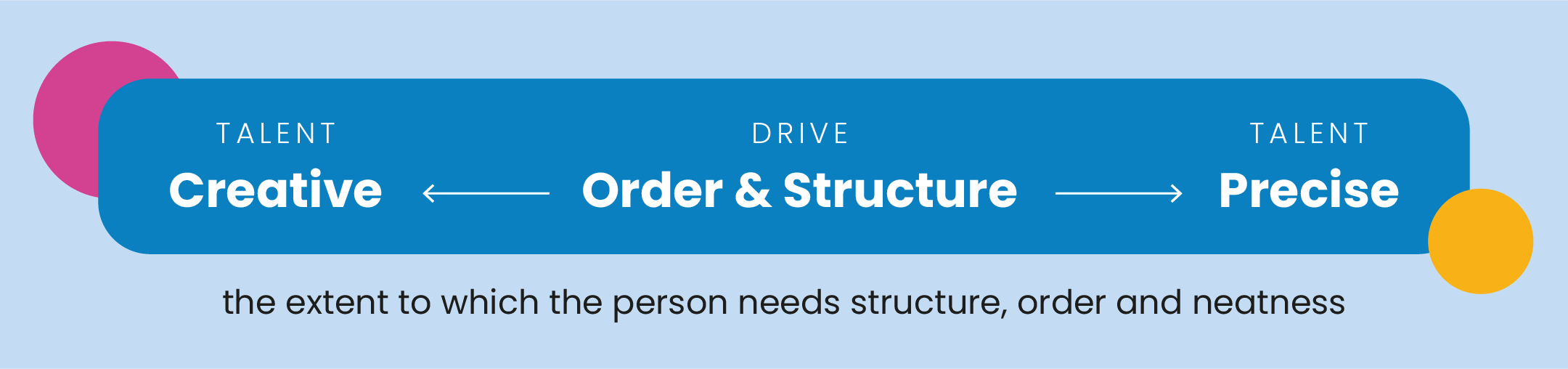
For example, one of the drives is Order and Structure. We define this drive as: The extent to which the person needs structure, order and neatness. Talents appear when there is either a low or high need for the drive. A balanced need (no low or high preference) indicates that there is no talent related to the drive.
Those with a low need for Order and Structure have a talent for Creativity. These individuals are driven by a focus on the bigger picture, are flexible, and have strong creative and innovative capabilities. Those with a high need for Order and Structure have a talent for Precision. They are driven by structure, like to start with a plan, and tend to be efficient. Those who don’t have a high or low need for Order and Structure are balanced. These individuals are able to pay attention to the bigger picture and work methodically and with focus on detail. They understand the importance of method but are flexible enough to adapt in changing circumstances.
Notice that there are no negative scores or results. All people have talents and all talents are good. A high score and a low score on the TMA Assessment for a specific drive are both framed positively, representing two different, valuable strengths. In this example, a low score on the drive for Order & Structure isn’t reported as a lack of discipline; it is framed as a talent for Creative or Flexible thinking, driven by a focus on the bigger picture. Being balanced is also valuable- it just doesn’t indicate a talent from that drive.
How Do Talents, Competencies, and the Environment Influence Behavior?
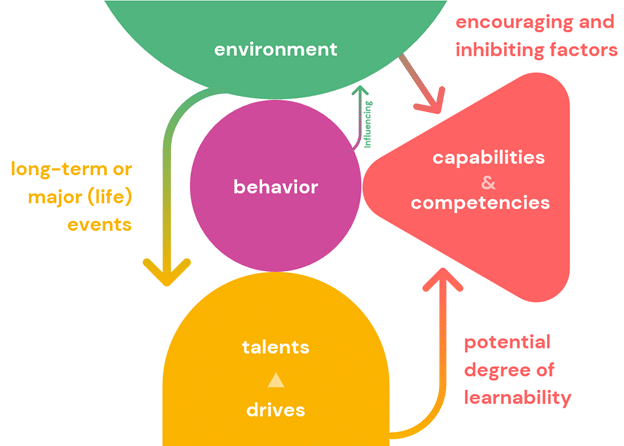
Talents are descriptions and behavioral statements and explanations of behavior that result from high and low drive needs. Drives and talents are the key factors that influence people’s behavior. Behaviors result from what an individual can do (cognitive capabilities and competencies), what they want to do (drives and talents), and the specific environment that might be stimulating or hindering behavior. Tasks and activities that align with personal drives and talents motivate individuals.
How Does the Environment Influence Talents and Behaviors?
The environment is a crucial factor that can either support or hinder the development and expression of an individual’s natural talents and competencies. People perform best, learn fastest, and are most engaged when their work and environment align with their natural talents and drives. When a work situation or environment is tailored to an individual’s personal preferences, it allows their talents to be expressed optimally.
A positive, talent-focused environment that values an individual’s unique strengths and provides opportunities for growth enhances self-worth, fosters social connections, and provides opportunities for self-improvement. This maximizes the chances for a person’s best behaviors and strengths to be utilized.
An unsuitable organizational culture or busy/distracting environment can lead to pitfalls, stress, and a lack of motivation, making it difficult for an individual to fully recognize or deploy their natural talents.
In essence, while an individual’s talents are considered stable, core components of their personality, the environment acts as the switch or fertilizer that determines whether those talents are fully utilized and translated into successful, observable performance and behavior.
How Do Talents Relate to Competencies?
Talents are the foundation for developing and expressing competencies. In essence, talents are what you naturally are, and competencies are the observable skills and behaviors you develop from those natural strengths.
| Talents | Competencies | |
|---|---|---|
| Definition | Natural strengths or preferred behaviors that stem from an individual’s intrinsic drives (motivations). | Observable behaviors that combine knowledge, skills, attitude, and personal qualities to achieve specific work goals. |
| Nature | Innate and relatively stable; the person you naturally are. | Learned and developed; the person you show at work. |
| Source | Arise directly from a strong drive (inner motivation/need). | Developed from a combination of talents, drives, skills, and abilities. |
| Development | Easy to apply and utilize; they are your personal source of power. | Easiest to develop in areas where an underlying natural talent exists. |
How Are Talents a Catalyst for Competency Development?
A natural talent acts as a powerful catalyst for acquiring a related competency. For example, a person with a strong talent for ‘Precise’ work (driven by a need for Order and Structure) will find it much easier to develop the competency of Attention to Detail than someone who lacks the underlying need for that drive.
The TMA method encourages organizations and individuals to focus on developing competencies that align with their strong, natural talents. When an individual’s job role requires competencies that match their talents, they perform better, learn faster, and are more engaged.
The TMA model emphasizes that you can teach skills, but you can’t teach talent. Therefore, identifying a person’s core talents is essential for predicting which competencies they can most easily and successfully master.
How Does the TMA Talent Assessment and Method Improve Employee Engagement?
The TMA Talent Assessment and Method improves employee engagement by ensuring a deep, fundamental alignment between an individual’s intrinsic motivation and talents and their work role and environment. The Method achieves this by creating a talent-oriented organization that prioritizes what people want to do and what they are naturally good at.
- Optimal Person-Job Alignment: The most direct path to engagement is achieved by matching people to roles where they can naturally excel.
- Personalized Development and Growth: Engagement is highly correlated with opportunities for continuous growth and development. The TMA Assessment provides objective, data-driven insight into an employee’s development potential and areas where they can most easily build new competencies.
- Fostering Self-Awareness and Self-Confidence: The non-judgmental and positive language of the TMA reports empowers employees. The assessment gives the employee a comprehensive, objective view of their own talents, motivations, and preferred working style. This self-awareness builds confidence and allows them to actively seek and structure work that aligns with their natural abilities.
- Improved Communication: Employees and managers gain a clear, shared language for discussing behavior and motivation. Managers can provide more effective and customized coaching tailored to the individual’s unique talent profile, fostering trust and a better working relationship.
- Improved Team Dynamics: By gaining insight into each other’s talents, team members can understand different behavioral preferences, divide workload more efficiently based on natural strengths, and communicate more effectively, leading to better collaboration and reduced conflict.
- Reduced Stress and Burnout: When employees consistently work against their natural grain (i.e., using low-scoring talents), it leads to stress and burnout. TMA helps minimize this by promoting work that is intrinsically easier and more energizing, thus increasing their sustained energy and dedication.
Measure and Leverage Talents to Increase Employee Engagement
While traditional engagement initiatives often focus on broad, top-down organizational actions, deficiencies in job fit are mostly overlooked due to difficulty in measuring individual drives and talents. The TMA Talent Assessment Approach offers a strengths-based, positive psychology framework to address this gap by quantifying 22 underlying drives to identify 44 unique talents, all framed in a non-judgmental way. By matching employees to roles where their innate talents serve as a natural catalyst for developing competencies, and by fostering a supportive environment that allows these talents to be optimally expressed, the TMA method boosts engagement, reduces stress, and creates a more collaborative and high-performing talent-oriented culture.
Join our EX Masterclass
Learn valuable principles of the employee experience, culture, employee listening, and much more when you incorporate and align talents and roles. Get insights from experts and begin designing the experience you want for your employees in your own organization.
Limited Time Offer!