
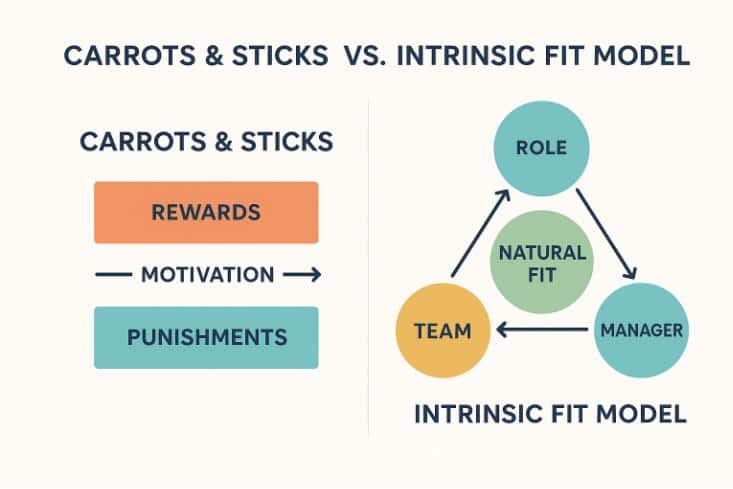
For decades, managers have utilized the same basic two levers to influence performance: rewards (carrots) and punishments (sticks). Bonuses, perks, titles, and recognition pull one way; performance plans, warnings, and consequences pull the other.
These levers aren’t useless, but they’re limited in their abilities. In modern organizations, where value comes from judgment, creativity, collaboration, and learning, transactional tactics alone rarely produce sustained excellence.
I would argue that the more powerful managerial lever is fit, which is aligning a person’s natural preferences, talents, and abilities with the demands of their role, the dynamics of their team, and their manager’s leadership style. When we understand what truly drives an individual, development becomes less about prescribing behavior and more about unlocking energy and potential.
This article offers a practical framework for HR professionals and talent leaders to improve employee performance using fit and intrinsic motivation as the focal points, drawing upon positive psychology and methodologies like TMA Talents.
Why Carrots and Sticks Fall Short
Carrots and sticks can shift short-term behavior, and they often produce quick results. Yet, these management techniques fail in the long-term for three primary reasons:
- They don’t build capability. Incentives can spur effort, but they don’t teach problem-solving skills, strengthen collaboration, or improve judgment. In other words, they don’t develop the competencies and capabilities that drive long-term performance.
- They ignore individual differences. People don’t respond uniformly to the same rewards or consequences. A spot bonus may motivate one person and leave another feeling listless. Consider how a public shout-out may motivate one team member and embarrass another.
- They crowd out intrinsic motivation. Overreliance on external rewards can reduce a sense of autonomy and purpose that fuels sustained employee engagement. Even well-intentioned managerial pressure can make work feel controlled rather than owned. No one wants to work for an obsessive micromanager.
The Science of Motivation: Intrinsic First
Positive psychology and decades of motivation research consistently point to the core psychological needs that sustain high performance:
- Autonomy (the sense of choice and ownership)
- Mastery (progress in competence)
- Purpose (meaning and impact)
When work satisfies these needs, individuals invest discretionary effort, learn faster, and persist through setbacks. Development that reinforces autonomy (e.g., choice in methods), fosters mastery (e.g., strengths-based stretch work), and connects to purpose (e.g., clear line-of-sight to valued outcomes) produces momentum that carrots and sticks can’t replicate.
Fit as the Foundation: Role, Team, and Manager
If motivation is the fuel, fit is the engine design, and three dimensions matter most:
- Role Fit: The match between a person’s natural drives and the tasks they perform most often. Someone that is energized by analysis and precision will thrive in roles requiring depth and accuracy. Someone driven by influence and variety will thrive in roles with high levels of interaction, frequent negotiation and creative problem-solving.
- Team Fit: Achieving alignment between an individual’s collaboration and communication style and the team’s working norms. A team with rapid iteration and experimentation may frustrate those who prefer thorough planning unless responsibilities are structured to respect both.
- Manager Fit: Compatibility between a person’s needs (e.g., autonomy, clarity, recognition) and the manager’s style. A manager who coaches for ownership can unlock a self-directed contributor, yet a manager who micromanages may unintentionally suppress natural strengths.
When these three dimensions are aligned, performance feels natura, like swimming with the current. Misalignment creates friction that no amount of incentives can overcome.
Understanding Drives and Talents: The TMA Approach
To design fit, you need visibility into what “natural” looks like for each person. This is where assessments of natural drives and talents are essential. The TMA methodology, which was developed in the Netherlands and widely used across industries, focuses on identifying stable, intrinsic drives (what energizes a person) and talent indicators (what they naturally do well).
It is important to note that a TMA profile doesn’t prescribe a career; it clarifies conditions for thriving. For example:
- A high drive for structure and accuracy suggests satisfaction in roles with clear processes, quality standards, and thorough analysis.
- A high drive for influence and variety suggests energy in roles with stakeholder engagement, persuasion, and novel challenges.
- A strong learning and curiosity drive points to stretch assignments, new domains, and a cadence of experimentation.
Used effectively, these insights guide development plans that amplify strengths, mitigate risk areas through design (e.g., teaming, tools, routines), and ensure coaching addresses what matters most to the individual.
Moving Beyond Incentives: What This Looks Like in Practice
Consider two development paths for the same performance goal: improving client renewal rates.
- Incentive-heavy path:
- Increase the renewal bonus, set stricter targets, add weekly compliance checks. You’ll likely get short-term effort, some gaming of the system, and uneven impact across the team.
- Fit-first path:
- Use talent insights to assign renewal conversations to reps who naturally enjoy stakeholder influence and relationship building.
- Pair data-driven reps (high accuracy and analysis drives) with relationship-oriented reps as “renewal pods,” blending strengths.
- Give autonomy to design outreach flows within clear guardrails.
- Coach to intrinsic motivators—progress dashboards for mastery-oriented reps; impact stories for purpose-oriented reps.
Result: capability grows, energy sustains, and renewals improve in a way that strengthens the system rather than straining it.
A Simple Framework: From Transactional “Carrots and Sticks” to Alignment
Use the following four-step model to shift from carrots and sticks to a fit-first development strategy:
- Map Drives and Talents
- Administer a strengths and drives assessment (e.g., TMA Talents) and create an individual profile: energizers, natural talents, context needs, and stretch opportunities.
- Summarize in one page: “What to lean on,” “What to watch for,” “Ideal conditions.”
- Diagnose Fit
- Role: Where do daily tasks align or clash with the person’s drives?
- Team: How do collaboration norms support or frustrate their style?
- Manager: What aspects of the manager’s approach (cadence, feedback, autonomy) enable or inhibit the person?
- Design Development on Strengths
- Assign strengthsbased stretch work: new responsibilities that require more of what energizes the person, with deliberate exposure to complementary demands.
- Shape conditions: clarify outcomes while offering method autonomy; define quality standards; build checkins aligned to preference (e.g., brief weekly touchpoints vs. monthly deep dives).
- Coach to Intrinsic Drivers
- Tie goals to personal motivators (progress for mastery, impact for purpose, choice for autonomy).
- Conduct “energy audits”: monthly conversations about tasks that energize vs. drain, adjust workload accordingly.
- Celebrate learning, not just outcomes, recognize process improvements, experiments run, and capability gains.
Common Objections and How to Respond
- “We can’t tailor everything.” — You don’t have to. Tailor the few conditions that matter most: who does what, how work is handed off, and how feedback happens.
- “People need to do what the role requires.” — Yes, and roles can often be shaped. Even small reallocations (e.g., moving stakeholder communication to those who enjoy it) unlock disproportionate value.
- “Incentives are part of our culture.” — Keep them, just don’t let them crowd out intrinsic drivers. Use incentives to recognize capability building and contribution to team health, not only short-term outputs.
Putting It All Together
Carrots and sticks have their place. But sustainable performance comes from fit and alignment: the right person, in the right role, with the right team and manager, under the right conditions. Development is most effective when it amplifies what’s natural, a person’s preferences, talents, and abilities, rather than fighting against them.
Join our EX Masterclass
Learn valuable principles of the employee experience, culture, employee listening, and much more when you incorporate and align talents and roles. Get insights from experts and begin designing the experience you want for your employees in your own organization.
Limited Time Offer!