
In the TMA (Talent Motivation Analysis) assessment, Emotional Balance is one of the six core dimensions used to map an individual’s personality and natural drives. It measures how a person manages internal and external pressure, their self-esteem, and their orientation toward authority and support. Individual talents in each of these areas strongly influence team dynamics. Managers who understand how these talents work together can better leverage the strengths of their team members to drive success.
How do Drives Influence Inherent Talents?
Drives are the building blocks of personality. In other words, drives define personality. Drives have a major influence on people’s behavior and (potential) development. The TMA Assessment measures 22 research-based Drives to define personality and measure individual talents. Talents are determined based on a person’s need or preference for each drive. The 22 talents are grouped into six Dimensions, one of which is Emotional Balance.
What is Emotional Balance?
Emotional Balance is defined as the degree to which an individual is mentally stable, resilient, and capable of maintaining composure in various circumstances. It specifically defines how one processes setbacks, handles stress, and views their own value in relation to others.
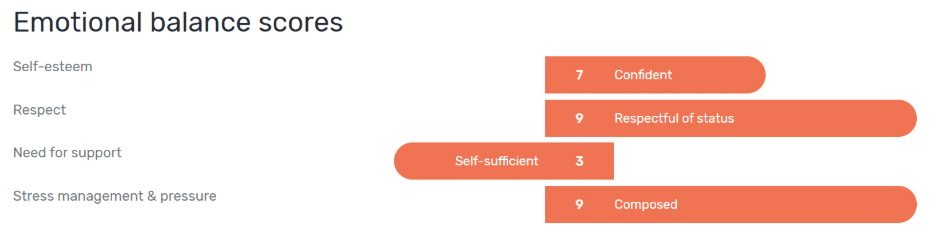
In the TMA assessment, Emotional Balance is broken down into four distinct groups or talents: Self-esteem, Respect, Need for Support, and Stress Management. The degree of preference in each area indicates a natural drive and every position on the scale offers unique value to a team. Conversely, when taken to an extreme, these talents can lead to potential pitfalls if not managed properly.
1. Self-esteem: The Internal Compass
Self-esteem in the context of the TMA assessment is the extent to which a person has self-esteem and confidence in their own abilities and worth, independent of external validation. It is the foundation of Emotional Balance. Self-esteem is measured inversely (with negative statements). This means that a person who often chooses items tagged for Self-esteem will score low on this TMA drive and vice versa.
High Score: The Confident Independent (Confident)
Individuals with a high score toward self-esteem are generally self-assured. They don’t need a “gold star” on every report to know they’ve done a good job. In a professional setting, this manifests as:
- Decisiveness: They trust their gut and their data.
- Resilience to Criticism: They view feedback as a critique of their work, not their worth.
- Risk-taking: They are more willing to pivot or try new strategies because their identity isn’t tied to 100% success.
- Potential Pitfall: May not take responsibility for mistakes and risk being overconfident.
Low Score: The Modest Perfectionist (Self-reflective)
A lower score for self-esteem often correlates with a need for external confirmation. However, this isn’t necessarily a weakness. These individuals are often:
- Highly Reflective: They double-check their work and care deeply about quality.
- Modest: They are excellent team players who rarely let ego get in the way of a collective goal.
- Sensitive to Environment: They thrive in supportive cultures where positive reinforcement is the norm.
- Potential Pitfall: Sometimes takes matters personally and can be too self-critical. May get overwhelmed in a stressful event.
Key Insight: A team of only high-self-esteem individuals can sometimes lead to “clashing egos,” whereas a balance allows for both bold direction and careful execution.
2. Respect: The Filter of Authority
The “Respect” talent measures an individual’s attitude toward hierarchy, rules, and traditional authority. It defines the “social contract” the employee signs with their organization.
High Score: The Loyal Guardian (Respectful of Status)
Those who have a high need for Respect value tradition and structure. They believe that for a system to work, there must be a clear chain of command and regard for authority.
- Reliability: They are the “rock” of the department, adhering to protocols and deadlines.
- Organizational Alignment: They find comfort in knowing exactly where they fit in the hierarchy.
- Predictability: You rarely have to worry about them “going rogue.”
- Potential Pitfall: May defer too much to other’s opinions and not speak up when needed.
Low Score: The Critical Challenger (Egalitarian)
A low score here suggests a “maverick” spirit. These individuals respect competence over titles.
- Innovation: They are the first to ask, “Why are we doing it this way?”
- Authenticity: They tend to be blunt and honest, which can be invaluable during a crisis when “yes-men” are dangerous.
- Flexibility: They adapt well to flat organizational structures or startups where roles are fluid.
- Potential Pitfall: May come across as contrarian for the sake of being difficult or be perceived as not a team player.
3. Need for Support: The Social Battery
This talent measures the extent to which a person requires encouragement, coaching, and a “safety net” from others to perform optimally.
High Score: The Collaborative Relater (Appreciates Support)
A high need for support indicates someone who views work as a social, collaborative effort.
- Team Cohesion: They are often the “glue” that keeps a team together.
- Coachable: They are sponges for mentorship and thrive under active management.
- Safety First: They prefer consensus-based decision-making, which reduces the margin for individual error.
- Potential Pitfall: Can be too inclusive, waiting for all to buy in before making a decision.
Low Score: The Self-Sufficient Specialist (Self-sufficient)
Low need for support characterizes the “lone wolf” or the highly autonomous operator.
- Autonomy: Give them a goal, and they’ll see you in three months with a finished product.
- Low Maintenance: They don’t require frequent 1-on-1s or constant recognition to stay motivated.
- Objective Focus: They are less likely to be swayed by office politics or the emotional climate of the room.
- Potential Pitfall: Can operate too independently without including others in necessary steps.
4. Stress Management: The Pressure Valve
Finally, Stress Management measures how an individual reacts when the stakes are high and the timeline is short. It distinguishes between those who are energized by pressure and those who are depleted by it.
High Score: The Calm Under Fire (Composed)
Those with a high need are the “ER Doctors” of the corporate world. When things go wrong, their heart rate stays steady. They tend to operate best under stress and lean into a crisis.
- Crisis Leadership: They can think logically when others are panicking.
- Long-term Endurance: They can handle high-pressure environments (like sales or emergency services) for extended periods without burning out.
- Emotional Distance: They can detach from work stress, ensuring it doesn’t bleed into their personal lives.
- Potential Pitfall: May delay tasks until the last moment. May come across as too unemotional or apathetic in stressful situations.
Low Need: The Sensitive Early-Warner (Responsive)
Individuals with lower stress management scores are more attuned to tension. While this sounds negative, it is a vital “canary in the coal mine” talent.
- Quality Control: Because they feel stress more acutely, they are motivated to prevent crises before they happen.
- Empathy: They are often more in tune with the stress levels of their colleagues.
- Detail Orientation: They tend to be thorough because the stress of making a mistake is a powerful motivator for accuracy.
- Potential Pitfall: Pressure and hectic situations may lead to an emotional response, even to panic.
The “Neutral” Zone: The Value of Mid-Range Needs
In the TMA assessment, many individuals fall in the middle of these scales. Having “no strong preference” is actually a talent in itself. It signifies Adaptive Balance. For example, a neutral Self-esteem score means the person can be confident when leading but remains open to feedback.
A neutral Stress Management score means they respect the urgency of a deadline without becoming paralyzed by it. These individuals often act as the “translators” in a team, bridging the gap between the extremes.
Summary of Emotional Balance Dimensions
Talent |
Talent Description |
Low-Score Trait |
High-Score Trait |
|---|---|---|---|
| Self-esteem | The extent to which the person has self-esteem and confidence in themselves | Self-reflective | Confident |
| Respect | The extent to which the person values the accomplishments and status of others. | Egalitarian | Respectful of Status |
| Need for Support | The extent to which the person needs support from others. | Self-sufficient | Appreciates Support |
| Stress Management & Pressure | The extent to which the person can handle stress and perform under pressure. | Responsive | Composed |
What is the Difference Between Emotional Balance and Emotional Intelligence?
While people often use “Emotional Balance” and “Emotional Intelligence” (EQ) interchangeably in casual conversation, the TMA Talent Method and the broader psychological concept of EQ (popularized by Daniel Goleman) serve two very different purposes.
The simplest distinction is that Emotional Intelligence is a set of skills you can develop, while TMA Emotional Balance is a set of natural drives and needs that dictate baseline behavior.
Skill vs. Drive (The “Can” vs. the “Will”)
- Emotional Intelligence (EQ): Focuses on competence. It asks: “How well can you recognize emotions in yourself and others, and can you regulate them to achieve a goal?” EQ is often seen as something that can be trained and improved over time.
- TMA Emotional Balance: Focuses on inclination. It asks: “What is your natural psychological makeup?” It doesn’t judge how “smart” you are with emotions; it measures how much pressure you naturally absorb, how much support you naturally crave, and how much you naturally respect hierarchy.
Internal Stability vs. External Awareness
The common understanding of EQ is heavily weighted toward Social Awareness and Relationship Management. The TMA dimension of Emotional Balance is much more focused on Internal Regulation and Environmental Needs.
Feature |
TMA Emotional Balance |
Emotional Intelligence (EQ) |
|---|---|---|
| Primary Goal | To understand an individual’s natural resilience and needs. | To measure an individual’s ability to navigate social complexities. |
| Key Metric | How much stress/autonomy/authority you naturally prefer. . | How well you read the room and manage your own reactions. |
| Changeability | Stable; reflects your core personality and “comfort zone.” | Malleable; can be increased through coaching and practice. |
| View of Low Scores | Not “bad”, simply a different talent (e.g., being “Responsive” vs “Composed”). | Often seen as a deficit that needs to be “fixed” or improved. |
The 4 Emotional Balance Drives vs. The 4 EQ Pillars
The difference is most visible when comparing the specific components of each.
The TMA Emotional Balance Drives
- Self-esteem: Your baseline confidence level.
- Respect: Your natural orientation toward authority and rules.
- Need for Support: Your natural requirement for external validation/help.
- Stress Management: Your natural “operating temperature” under pressure.
The EQ Pillars
- Self-Awareness: Knowing what you are feeling and why.
- Self-Management: Controlling impulsive feelings and behaviors.
- Social Awareness: Understanding the emotions and needs of others (Empathy).
- Relationship Management: Influencing, coaching, and managing conflict.
Why the Distinction Matters
In a professional setting, you might have a manager with High Emotional Intelligence (they are great at reading the room and saying the right thing) but Low Emotional Balance (they feel stress acutely and have a high need for support).
Conversely, you might have a “Composed” individual with High Emotional Balance (they stay calm in a crisis) who has Low EQ (they have no idea that their calm demeanor is actually coming across as cold or insensitive to their panicking team).
The Insight: EQ tells you how a person interacts with the world, while TMA Emotional Balance tells you what that person needs from the world to stay productive.
Applying Emotional Balance to Team Dynamics
Emotional Balance in the TMA framework isn’t a “pass/fail” test. It’s a map of an individual’s internal landscape. A successful organization realizes that it needs the Critical Challenger (Egalitarian) to innovate, the Confident Independent (Confident) to lead, the Collaborative Relater (High Need for Support) to build culture, and the Sensitive Early-Warner (Responsive) to ensure the team doesn’t take unnecessary risks.
By identifying these talents, leaders can stop managing by “gut feeling” and start managing by design, ensuring every employee is utilized in an environment where their natural emotional rhythm leads to peak performance.