

Most leaders agree that honesty, integrity, and trust are essential to ethical leadership. Yet those three words are often used interchangeably, even though they point to different behaviors.
Definitions
- Honesty means telling the truth in ways that help people see reality clearly.
- Integrity means aligning decisions and actions with stated values, especially when pressure makes compromise tempting.
- Trust means earning others’ confidence that you are competent, dependable, relationally safe, and motivated by shared success rather than self-interest.
Together, these qualities form the foundation of ethical leadership:
Honesty clarifies the truth, integrity guides the choice, and trust makes sustained influence possible.
A leader can be honest in a single conversation, demonstrate integrity across many decisions, and earn trust over time through a consistent pattern of competence, reliability, relationship, and motives. Understanding the difference matters because people do not experience these concepts as abstract virtues; they experience them through observable behavior.
Think of an ethical leader you know who exemplifies honesty, integrity, and trust. What specific behaviors cause you to experience this leader as upright, candid, principled, and trustworthy? Some people point to transparency. Others point to courage, follow-through, confidentiality, humility, fairness, or willingness to put the team’s interest ahead of personal advantage. The variety of answers is not a problem; it is a reminder that leaders must define the behaviors they want to be known for and then ask stakeholders whether those behaviors are actually being seen.
Compare and Contrast: Honesty, Integrity, and Trust
| Concept | Core Meaning | Primary Question | Observable Behaviors | Risk When Missing |
|---|---|---|---|---|
| Honesty | Truthful, accurate, and candid communication. | Are you telling me the truth? | Shares relevant facts, acknowledges uncertainty, corrects errors, avoids misleading omissions. | Confusion, rumors, poor decisions, and loss of credibility. |
| Integrity | Consistency between values, words, decisions, and actions. | Will you do what is right? | Keeps principles under pressure, treats people fairly, accepts accountability, applies standards consistently. | Cynicism, ethical drift, favoritism, and weakened culture. |
| Trust | Confidence in another person’s competence, reliability, relationship, and motives. | Can I rely on you with what matters? | Follows through, protects confidences, advocates fairly, acts in the team’s best interest. | Defensiveness, reduced collaboration, slower decisions, and lower commitment. |
Honesty: Definition and Leadership Examples
Honesty is the practice of communicating truthfully and accurately. In leadership, honesty includes telling the truth, sharing relevant information, correcting misunderstandings, acknowledging uncertainty, and avoiding misleading omissions. Honesty is not the same as saying everything one thinks. Rather, it is the disciplined practice of being candid in ways that help people make better decisions and understand reality more clearly.
For example, an honest leader tells a client when a project is behind schedule rather than hiding the delay until the final week. An honest manager says, “I do not know yet, but I will find out by Friday,” instead of pretending to have an answer. An honest executive explains the trade-offs behind a decision, including what the organization is gaining and what it is risking. Honesty may also be seen as openness: a willingness to discuss issues before all the data is complete, when alternatives are still forming, and before decisions are final.
Integrity: Definition and Leadership Examples
Integrity is alignment between values, words, decisions, and actions. Integrity shows up when leaders do the right thing even when it is inconvenient, unpopular, costly, or difficult to observe. A leader with integrity does not merely know the organization’s values; the leader applies them when making decisions about people, customers, resources, and results.
For example, a leader demonstrates integrity by speaking up when a plan conflicts with stated values, even if a senior sponsor prefers silence. A leader shows integrity by refusing to manipulate numbers to make a quarter look better, by giving credit to the team rather than taking credit personally, and by applying standards consistently across high performers and favorites. Integrity is also interpreted as courage and work ethic: being willing to raise a difficult issue, make an unpopular decision, or stay with a problem until the right work is done well.
Trust: Definition and Leadership Examples
Trust is the confidence that another person will act competently, reliably, and with appropriate concern for others’ interests. Trust is partly rational and partly relational. People trust leaders when they believe the leader can do the work, will do what they promise, will handle sensitive matters appropriately, and will not put self-interest ahead of the team or organization.
For example, trust grows when a leader protects a team member’s reputation while that person is not in the room, represents another person’s point of view fairly, and makes decisions that balance business outcomes with respect for people. Trust also grows through ordinary dependability: showing up prepared, meeting deadlines, keeping confidences, and communicating early when priorities change. Trust is lost when people sense hidden agendas, inconsistency, blame shifting, or selective truth-telling.
The Trust Equation

The Trust Equation provides a practical way to understand why people experience a leader as trustworthy. In the model popularized by the book The Trusted Advisor, trustworthiness increases when credibility, reliability, and intimacy are high, and decreases when self-orientation is high. Put simply: Trustworthiness = (Credibility + Reliability + Intimacy) / Self-Orientation. People trust leaders who are capable, dependable, relationally safe, and focused on something larger than themselves.
- Credibility (Competence): Others believe you know what you are talking about and have the skill to make good judgments. Will you do a good job?
- Reliability: Others believe you will do what you say, when you say you will do it, and with the quality expected. Will you complete the task on time?
- Intimacy (Relationship): Others feel safe sharing information, concerns, or disagreement with you because you listen, respect confidentiality, and respond constructively. How well do I know you?
- Self-Orientation (Motivation): Others judge whether you are acting for the good of the person, team, customer, or organization—or mostly for yourself. What is your intent?
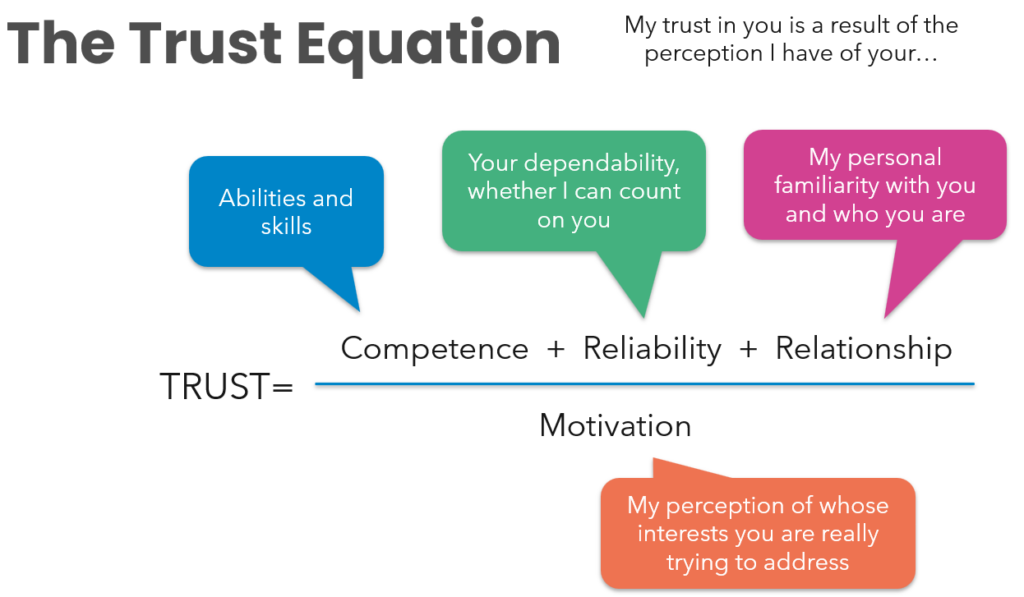
Download a PDF of The Trust Equation model
How to Measure Honesty, Integrity, and Trust in a 360 Survey
- Use behavior-based items. Ask raters to evaluate specific actions they have observed in the last six to twelve months rather than asking whether the person “has integrity” in general.
- Use multiple rater groups. Include manager, peers, direct reports, and key stakeholders so the leader can see patterns across relationships.
- Separate the three concepts. Measure honesty, integrity, and trust with distinct items so the feedback shows where the leader is strongest and where improvement is needed.
- Use a clear scale. A seven-point scale from “Very Poor” to “Outstanding” with a “Don’t Know” option will show clear differences in perceptions by rater group.
- Ask for open-text examples. Comments make the scores more actionable and reduce the risk of vague praise or vague criticism.
10 360 Feedback Survey Questions to Measure Honesty, Integrity, and Trust
- Communicates relevant information truthfully, even when the message is difficult.
- Acknowledges mistakes and corrects inaccurate information.
- Acts consistently with stated values under pressure.
- Applies standards fairly across people and situations.
- Can be trusted to represent others’ interests when they are not present.
- Keeps confidential information appropriately.
- Places the good of the team or organization ahead of personal agenda.
- Consistently follows through on promises and commitments.
- Is honest, ethical, and trustworthy.
- Takes responsibility for their own actions.
Report 360 survey results by competency, rater group, and item. The most useful 360 report shows both strengths and gaps. For example, a leader may score high on reliability but lower on openness, or high on honesty with peers but lower with direct reports.
Scale: 1-Very Poor, 2-Poor, 3-Fair, 4-Average, 5-Good, 6-Excellent, 7-Outstanding

Download a Sample 360 Feedback Report
Practical Recommendations for Improvement
To improve Honesty, increase the frequency and quality of truthful communication. Share context earlier, state what is known and unknown, and avoid over-polishing messages until they become vague. Use phrases such as “Here is what I know,” “Here is what I do not know yet,” and “Here is what could change.” Invite disagreement before decisions are final. When facts change, update people quickly and explicitly. Most importantly, correct your own misstatements publicly enough that people see truth matters more than image.
To improve Integrity, define the principles that will guide your decisions before pressure arrives. Write down the few values you will not trade off, then connect decisions back to those values. Ask, “Would I make the same decision if this were visible to the whole organization?” and “Am I applying the same standard to this person that I would apply to someone with less influence?” Build a habit of accepting accountability: name the mistake, explain the correction, and follow through. Integrity strengthens when people see consistency over time.
To improve Trust, work on all four elements of the Trust Equation. Build credibility by deepening expertise and being honest about limits. Build reliability by making fewer vague promises and tracking every commitment. Build relationship by listening carefully, protecting confidences, and responding well when people raise concerns. Reduce self-orientation by asking better questions, summarizing others’ interests before advocating your own, and making trade-offs transparent. Trust grows when people repeatedly experience that you are capable, dependable, safe, and focused on shared success.
How to Recover when Honesty, Integrity, and Trust Have Been Compromised
Recovering when Honesty, Integrity, and Trust have been compromised requires more than an apology; it requires visible ownership, corrected behavior, and consistent follow-through over time. The leader should first acknowledge specifically what happened, who was affected, and why the behavior fell short of expectations. Next, the leader should take responsibility without defensiveness, make appropriate amends, and explain what will change to prevent the issue from recurring. Recovery also requires inviting feedback from those affected, listening without arguing, and allowing people time to observe a new pattern of behavior. Honesty is restored through transparent communication, integrity is restored through actions that align with stated values, and trust is restored when people repeatedly see reliable, other-centered behavior after the breach.
8 Tips for Dealing with a Manager who Lacks Honesty, Integrity, and Trust
It can be incredibly challenging to work for a manager who is deficient in any of these areas. Dealing with a manager who lacks honesty, integrity, and trust requires a balance of professionalism, self-protection, documentation, and escalation when necessary.
Here are eight practical tips:
- Clarify the pattern, not just one incident. Ask yourself whether the issue is a misunderstanding, a one-time mistake, or a repeated pattern of misleading communication, broken commitments, unfairness, or self-serving behavior.
- Document facts objectively. Keep records of commitments, decisions, dates, emails, and outcomes. Avoid emotional labels in your notes; focus on observable behavior: what was said, what was done, and what impact it had.
- Communicate directly when safe and appropriate. If the situation is not severe or unethical, have a private conversation. Use neutral language such as: “I want to clarify expectations because I understood the commitment differently,” or “When the direction changed after our conversation, it created confusion for the team.”
- Set boundaries. Confirm important decisions in writing, avoid relying on verbal promises alone, and be careful about sharing sensitive information if confidentiality has been violated.
- Do not mirror the behavior. Maintain your own honesty, integrity, and trustworthiness. A manager’s poor behavior can pressure others to become defensive, political, or deceptive, but protecting your own standards matters.
- Seek advice from a trusted source. Talk with HR, a mentor, ethics/compliance, or a higher-level leader if the behavior affects people, customers, finances, safety, or legal/ethical obligations.
- Escalate when necessary. If the manager’s behavior involves dishonesty, retaliation, discrimination, harassment, fraud, or serious ethical concerns, use the organization’s formal reporting channels.
- Decide whether the environment is sustainable. If the pattern does not change and leadership does not address it, you may need to protect your well-being and career by seeking a transfer, changing reporting lines, or eventually leaving the organization.
A concise way to frame it is: Address what you can, document what you observe, protect your standards, escalate real risk, and make a thoughtful decision about whether the relationship or environment can be repaired.
6 Tips for Coaching a Leader Who Lacks Honesty, Integrity, and Trust
Coaching a leader in this area requires directness, care, and a focus on observable behavior rather than labels. Begin by creating psychological safety and clarifying that the goal is development, not personal judgment. Use specific examples from feedback, 360 survey results, or stakeholder interviews to show the pattern: what the leader said, what the leader did, and how others experienced the gap. Avoid saying, “You lack integrity,” and instead say, “Several stakeholders described situations where commitments changed without explanation, which caused them to question reliability and transparency.”
- Start with self-awareness. Help the leader compare intent with impact. Many leaders believe they are being practical or protecting people, while others experience the same behavior as withholding, inconsistency, or avoidance.
- Define the behavior standard. Translate honesty, integrity, and trust into a few concrete expectations, such as telling the full truth early, keeping commitments, explaining changes, protecting confidences, and acknowledging mistakes quickly.
- Use real scenarios. Ask the leader to identify recent moments when pressure, fear, politics, or self-interest may have influenced communication or decisions. Then rehearse how the leader could respond differently next time.
- Focus on repair, not image management. Encourage the leader to acknowledge specific breaches, make amends where appropriate, and communicate what will change. A vague apology rarely rebuilds trust; consistent changed behavior does.
- Create accountability mechanisms. Have the leader commit to a small number of visible actions and ask a trusted peer, manager, or coach to monitor follow-through over time.
- Measure progress. Revisit 360 survey items, stakeholder check-ins, or pulse feedback after several months to see whether people are experiencing more honesty, integrity, and trust in practice.
The coach’s role is to challenge the leader firmly while preserving the leader’s dignity. The most effective coaching conversation helps the leader see that trust cannot be demanded by title or authority; it must be earned through repeated moments of truth, principled choices, and reliable follow-through. When the leader accepts ownership and practices new behaviors consistently, stakeholders can begin to recalibrate their expectations and decide whether trust is being rebuilt.